Understanding Indexed Universal Life (IUL): Protection, Cash Value and Long-Term Flexibility

Understanding Indexed Universal Life (IUL): Protection, Cash Value and Long-Term Flexibility
Indexed Universal Life insurance combines permanent life insurance protection with the potential to accumulate cash value over time. Understanding how it works—including its costs, flexibility, potential benefits and risks—can help you decide whether it deserves a place in your long-term financial strategy.
Life insurance is primarily designed to provide financial protection for the people who matter to you. Some permanent life insurance policies, however, also provide a cash-value component that may accumulate over time.
Indexed Universal Life insurance, commonly called IUL, is one such option.
IUL has received considerable attention because it combines a death benefit with flexible policy features and interest-crediting strategies linked to the performance of an external market index.
But an IUL is not a stock-market investment, savings account, or retirement account, and its results are not guaranteed simply because an index performs well.
Before deciding whether an IUL is appropriate, it is important to understand what you're actually purchasing and how the policy works.
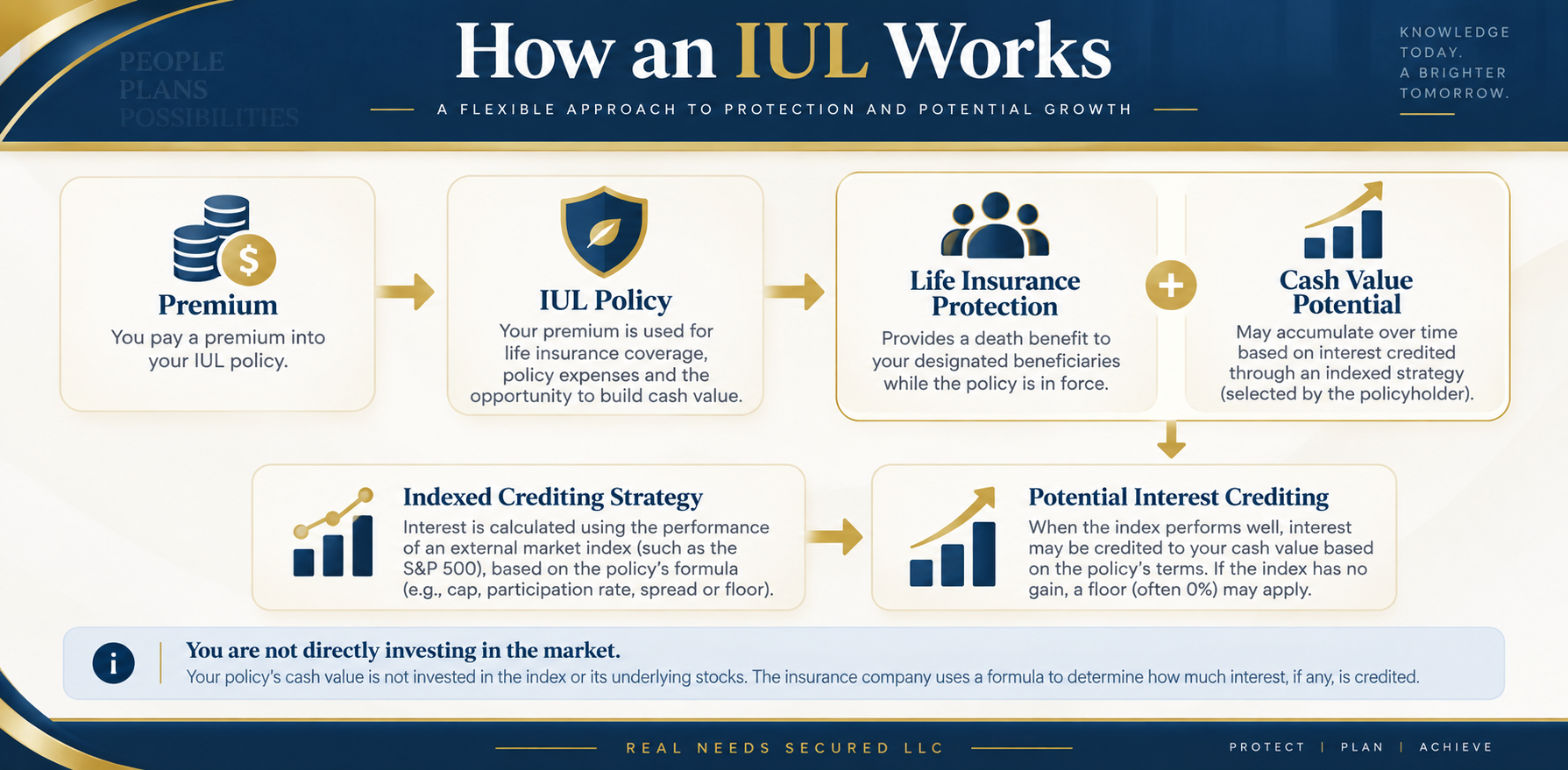
What Is Indexed Universal Life Insurance?
Indexed Universal Life is a form of permanent life insurance.
Unlike term insurance, which is generally designed to provide coverage for a specified period, an IUL can remain in force for life provided the policy remains adequately funded and its requirements are met.
Part of the premiums paid into the policy goes toward the cost of insurance and other policy charges. Depending on the policy and how it is funded, cash value may accumulate over time.
The policyholder may generally choose among one or more interest-crediting strategies. Some of these strategies calculate credited interest using the performance of an external market index.
One familiar example is the S&P 500, although available indexes and strategies vary by insurance company and policy.
Importantly, your policy's cash value is not directly invested in the index or its underlying stocks.
Instead, the insurance company uses a formula specified in the policy to determine how much interest, if any, is credited to the applicable indexed account.
How Indexed Interest Crediting Works
This is one of the most important concepts to understand about an IUL.
An indexed strategy typically uses changes in a specified market index as part of the formula for determining credited interest.
Depending on the policy, that calculation can involve features such as:
Floor: A minimum indexed interest-crediting rate for the indexed strategy.
Cap: A maximum rate that may be credited during a particular crediting period.
Participation Rate: The percentage of an index's calculated gain used in determining credited interest.
Spread: Some strategies deduct a specified percentage from the calculated index return instead of—or in addition to—using other limitations.
These provisions vary substantially among insurers and products and may change when permitted by the contract.
What does a 0% floor actually mean?
You'll frequently hear that an IUL provides a 0% floor.
That needs some context.
A 0% floor generally refers to the minimum indexed interest credited under a particular strategy. It does not necessarily mean your overall policy value cannot decline.
Insurance costs and other policy charges may still be deducted even during a period when the indexed strategy receives no positive credited interest.
New York's Department of Financial Services specifically warns consumers that universal-life policies require attention to funding and that mortality and expense charges can affect policy performance.
So a better way to understand the concept is:
An indexed strategy can provide protection against receiving negative index-based interest crediting, but that is not the same thing as guaranteeing that the policy's total cash value can never decrease.

The Life Insurance Protection Comes First
An IUL should first be understood as life insurance.
When the insured dies while the policy is in force, the insurance company pays the applicable death benefit to the designated beneficiary or beneficiaries.
Life insurance can help families address financial needs such as:
Income replacement
Mortgage or housing obligations
Outstanding debts
Education funding
Final expenses
Business or estate-planning needs
Leaving a financial legacy
Life-insurance death benefits are generally excluded from a beneficiary's gross income for federal income-tax purposes, although exceptions exist. Tax treatment can depend on the circumstances surrounding the policy.
Building Cash Value
An IUL can also accumulate cash value.
Cash-value accumulation depends on numerous factors, including:
Premium funding
Cost of insurance
Policy expenses and charges
Interest credited
Policy withdrawals
Outstanding loans
Changes to policy benefits
How long the policy remains in force
This is why two people who own IUL policies may experience very different outcomes.
The word “indexed” does not guarantee a particular return.
And projections appearing in a life-insurance illustration can include both guaranteed and non-guaranteed elements.
New York requires life-insurance illustrations to identify these distinctions and prohibits presenting non-guaranteed elements as though they were guaranteed.
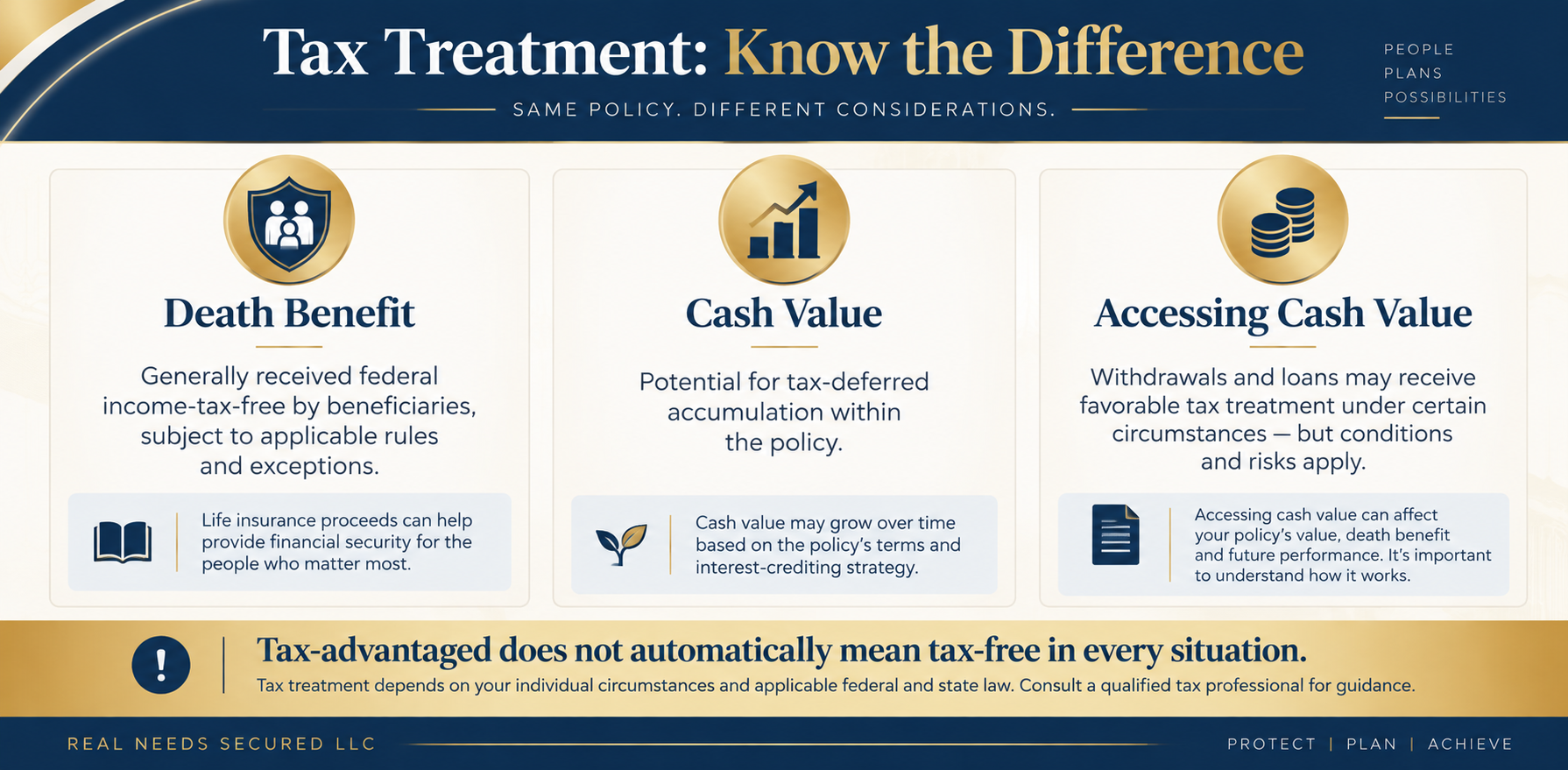
Accessing Your Cash Value
One feature that attracts attention to permanent life insurance is the potential ability to access accumulated cash value while the insured is alive.
Depending on the policy, cash value may be accessed through:
Withdrawals
and/or
Policy loans
That flexibility can potentially provide access to funds for a variety of needs.
However, accessing cash value isn't the same as withdrawing money from a checking account.
Withdrawals and loans can affect:
Available cash value
Policy performance
Death benefits
Future funding requirements
The policy's ability to remain in force
Interest is generally charged on policy loans as provided by the contract.
If a policy with an outstanding loan eventually lapses or is surrendered, there can also be tax consequences.
For these reasons, policy loans should be understood and managed carefully rather than presented simply as “free money.”
What About “Tax-Free Retirement Income”?
You've probably seen IUL described online as providing “tax-free retirement income.”
That phrase requires important qualifications.
Properly structured permanent life insurance can offer certain federal income-tax advantages. Under appropriate circumstances, policyholders may be able to access cash value through withdrawals and policy loans without immediately creating taxable income.
But the result depends on factors including:
How the policy was funded
The owner's cost basis
Whether withdrawals or loans are used
Whether the contract becomes a Modified Endowment Contract (MEC)
Whether the policy remains in force
Applicable tax law
An IUL should therefore not be described as automatically producing tax-free retirement income.
Instead, it may provide a source of potentially tax-advantaged access to cash value when properly structured and maintained.
Anyone considering substantial cash-value distributions should discuss the tax consequences with an appropriate tax professional.
Understanding MEC Rules
Tax treatment is also one reason proper policy design matters.
Federal tax law includes rules intended to distinguish life insurance from contracts funded primarily for investment purposes.
If too much premium is placed into certain life-insurance policies relative to the death benefit within applicable limits, the contract can become a Modified Endowment Contract, or MEC.
A MEC remains life insurance, but the tax treatment of distributions can change significantly.
That's why an IUL designed for cash-value accumulation needs to be monitored carefully.
More premium isn't automatically better.
The policy has to remain within applicable tax-law requirements if maintaining non-MEC treatment is part of the owner's objective.
Is There a Contribution Limit?
Another common statement online is:
“IULs have unlimited contributions.”
That's misleading.
An IUL isn't governed by the annual contribution limits that apply to certain qualified retirement accounts, but that does not mean you can simply put an unlimited amount of money into a policy while preserving all of its intended life-insurance tax characteristics.
The amount of premium that can be placed into a policy depends on factors such as:
Death benefit
Policy design
Age and underwriting
Policy provisions
Federal tax-law limits
Proper funding is therefore an important part of IUL design.
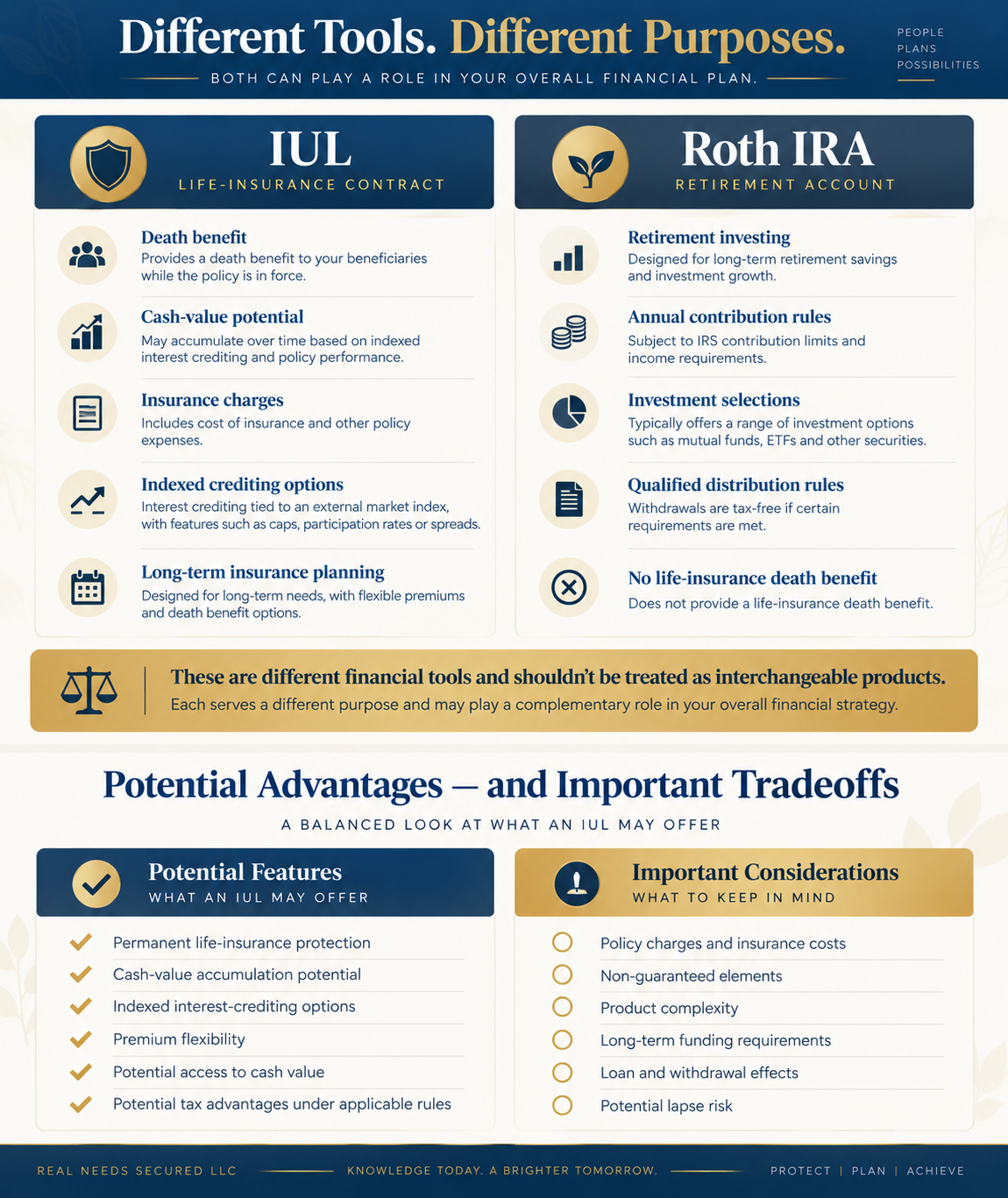
IUL vs. Roth IRA: Understand the Difference
IUL policies are sometimes compared with Roth IRAs because both may involve tax-advantaged financial planning.
But they are fundamentally different.
A Roth IRA is a retirement account.
An IUL is a life-insurance contract.
A Roth IRA is generally designed specifically for retirement investing and is governed by contribution, income, distribution and other tax rules.
An IUL's primary foundation is life insurance. Its cash value is a feature of that insurance contract.
For many people, the appropriate question isn't:
“Should I buy an IUL instead of a Roth IRA?”
A better question is:
“What financial purpose am I trying to accomplish, and which tools are appropriate for that purpose?”
Life insurance, employer-sponsored retirement plans, IRAs, emergency savings and other financial tools can serve different purposes.
They don't necessarily need to compete with one another.
Potential Advantages of an IUL
Depending on the policy and the individual's objectives, an IUL may provide several potential advantages.
Permanent Life Insurance Protection
Coverage may remain in force for life when the policy is sufficiently funded and contractual requirements are satisfied.
Cash-Value Accumulation Potential
Cash value may accumulate over time based partly on interest credited under the policy's available strategies.
Indexed Interest-Crediting Options
Certain strategies provide interest-crediting potential linked to the performance of an external index without directly investing policy cash value in that index.
Flexible Premium Structure
Universal life generally provides more premium flexibility than some other forms of permanent insurance, subject to maintaining sufficient policy value and meeting policy requirements.
Access to Cash Value
Available cash value may potentially be accessed through withdrawals or policy loans.
Death Benefit
The policy provides a death benefit to beneficiaries while coverage remains in force.
Potential Tax Advantages
Life insurance receives certain favorable treatment under federal tax law when applicable requirements are satisfied.
The Tradeoffs Matter Too
An IUL isn't appropriate for everyone.
Understanding its limitations is just as important as understanding its potential benefits.
Policy Charges
IUL policies can include cost-of-insurance charges, administrative expenses, surrender charges and other costs.
Non-Guaranteed Performance
Illustrated cash values and interest crediting can contain non-guaranteed assumptions.
Actual results may be higher or lower than illustrated.
Complexity
IUL contracts can be considerably more complicated than term life insurance.
Long-Term Commitment
Cash-value life insurance is generally better evaluated over a long time horizon rather than as a short-term savings vehicle.
Funding Matters
Insufficient funding, policy loans, withdrawals, changing charges or lower-than-anticipated credited interest can affect policy performance.
Lapse Risk
If a policy does not maintain sufficient value to support its charges, coverage can eventually lapse unless additional premium is provided.
This is particularly important when substantial policy loans are outstanding.
New York DFS advises consumers to consider whether they can afford coverage over an extended period and to ask whether premiums, death benefits or cash values can change over time.
Why Your IUL Illustration Matters
Before purchasing an IUL, you may receive a life-insurance illustration.
The illustration is extremely important—but it should not be mistaken for a promise of future performance.
It can show how a policy may perform under specified assumptions and distinguish between guaranteed and non-guaranteed elements.
New York's illustration rules specifically prohibit representing a life-insurance policy as something other than life insurance and prohibit presenting non-guaranteed elements in a misleading manner or implying that they are guaranteed.
When reviewing an illustration, don't focus only on the largest projected cash-value number.
Ask:
What is guaranteed?
What isn't guaranteed?
How much premium is assumed?
How long is that premium expected to be paid?
What policy charges apply?
What happens under less favorable assumptions?
How would loans or withdrawals affect the policy?
At what point could additional premium become necessary?
What happens if credited interest is lower than illustrated?
New York DFS recommends that consumers request a sales illustration, when available, before purchasing coverage.
Who Might Consider an IUL?
Rather than saying IUL is “for the wealthy” or “for everyone,” it is better to evaluate whether the characteristics of the policy match an individual's needs.
An IUL may be worth discussing when someone:
Has a legitimate need for permanent life insurance
Wants the potential to accumulate cash value
Has a long-term financial horizon
Can consistently fund the policy
Understands that illustrated values aren't guaranteed
Values premium and death-benefit flexibility
Understands the costs and risks associated with the policy
Other individuals may find that term life, whole life or another insurance solution better matches their needs.
The appropriate solution depends on the person—not on which product is receiving the most attention online.
Questions to Ask Before Purchasing an IUL
Before making a decision, consider asking your insurance professional:
What portion of this illustration is guaranteed and what is not?
What are the policy's current and maximum charges?
What happens if credited interest is lower than illustrated?
How much premium is expected, and for how many years?
What indexed strategies are available?
How do caps, participation rates, spreads or other crediting provisions work?
What surrender charges apply?
How would withdrawals affect the policy?
How do policy loans work and what interest is charged?
What could cause the policy to lapse?
What happens if I can no longer fund the policy as planned?
How is the policy being designed to avoid unintended MEC status, if that is an objective?
Those questions can tell you considerably more than simply asking what return an illustration shows.
Learn Before You Decide
Indexed Universal Life insurance can provide a combination of permanent life insurance protection, cash-value accumulation potential and policy flexibility.
But those features come with costs, conditions and risks that deserve to be understood.
An IUL shouldn't be selected simply because someone calls it a “wealth strategy,” “tax-free retirement plan,” or “market protection.”
It should be evaluated as a life-insurance contract.
The right questions are:
What do you need to protect?
How long do you need coverage?
What can you comfortably afford?
What financial objective are you trying to accomplish?
And does this particular policy appropriately support that objective?
Understanding those answers is far more important than choosing a product based on a headline.
Ready to Learn More?
At Real Needs Secured LLC, our goal is to help individuals and families understand their life-insurance options before making a decision.
If you'd like to explore Indexed Universal Life insurance, we can help you review how the coverage works, understand an illustration, and discuss whether an IUL—or another type of life insurance—may fit your needs.
Schedule a Complimentary Insurance Consultation
No obligation. Education first.
Educational Disclosure
This material is provided for general educational purposes and is not intended as tax, legal, investment or accounting advice. Indexed Universal Life is a life-insurance product, not a direct investment in a market index. Policy features, guarantees, charges, indexed-crediting methods, loan provisions, riders and availability vary by insurer and contract. Non-guaranteed values may change, and policy loans and withdrawals can reduce cash value and death benefits and may increase the risk of lapse. Tax treatment depends on individual circumstances and applicable law. Consult an appropriate tax or legal professional regarding your specific situation.
Real Needs Secured LLC
New York Independent Life, Accident and Health Insurance Agent